SETTING THE TONE
MY FIRST TEAM
A little book about trying hard, having fun and being a good teammate
TRY HARD. HAVE FUN. BE KIND.
A guide for athletes in Soccer, ages 4-8
1 / 14
A guide for athletes in Soccer, ages 4-8
A guide for athletes in Soccer, ages 4-8
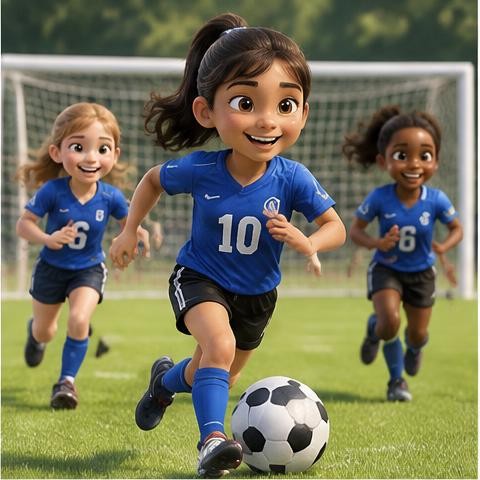
You have a team now. That means you have new friends, a coach who helps you, and a match to learn.
You do not have to be the best. You just have to show up, try hard, and be a good teammate.
You may feel excited and nervous at the same time. Find one teammate, say hello, and join the first warm-up.
“I am here to learn and have fun.”
Do one brave team thing today: greet, try, help, or ask.
You will miss. You will fall. You will run the wrong way sometimes. Every single player does.
When it happens, take a breath and say two words to yourself: next play.
If you miss and feel like crying, step to a safe spot, tell a grown-up, breathe once, and choose one small next job.
“Oops. Next play!”
Practice saying ‘I’m upset, but I can try the next one.’
A great teammate cheers when somebody else does something good. A great teammate helps pick up the equipment.
You can be the kid everybody is happy to see at practice. That is a real talent.
If someone is left out, move over and say, ‘You can be with us.’ If someone keeps being mean, tell Coach or your grown-up.
“Nice job! You got this!”
Invite one teammate into a drill, line, or celebration.
Your coach will tell you where to stand and what to do. Look at your coach when they talk. Then go do it as fast as you can.
If you do not understand, that is okay. Raise your hand and ask.
If Coach gives three directions and you remember only one, ask, ‘What do I do first?’ That is smart listening.
“Coach, can you show me one more time?”
Repeat the first job back to Coach before you begin.
Sometimes you will be so excited you want to jump. Sometimes you will be sad or mad. Both are okay.
Take three slow breaths. Tell a grown-up how you feel. Then get back to your team.
Mad, sad, scared, and excited are all okay. Hurting someone, breaking equipment, or hiding pain is not the answer.
“I feel mad right now. I'm taking a breath.”
Use three steps: stop, breathe, tell a trusted grown-up.
The score will not matter in a week. The way you felt running around with your friends will.
Smile. Run fast. Get a little dirty. That is what this is for.
You can work hard and still laugh, celebrate a friend, and enjoy learning something new.
“That was fun. I want to do it again.”
After practice, name one hard thing and one fun thing.
Look around your team. Somebody is tall. Somebody is tiny. Somebody was born almost a whole year before you. That is not because they are better — it is because bodies grow at different speeds, like plants in the same garden.
Your body will keep changing on its own schedule. Keep showing up and practicing so you can grow your skills, whatever size you become.
If another player is bigger, notice a skill you can use now—quick feet, listening, balance, courage, or kindness.
“My body is growing on its own time. I just keep practicing.”
Choose one skill to practice five minutes at a time with a grown-up.
Here is a secret: telling a teammate they did something awesome does not use up any of your awesome. There is plenty for everybody.
If you are strong and your friend is fast, your team just got two superpowers. That's better than one.
If someone is left out, move over and say, ‘You can be with us.’ If someone keeps being mean, tell Coach or your grown-up.
“Nice job! That was awesome!”
Invite one teammate into a drill, line, or celebration.
If you don't understand something, or you want to play a different spot, you are allowed to ask. Coaches love questions — they just don't love them in the middle of a play.
Wait for a water break or the end of practice, walk up, look at your coach, and use your words.
If you are confused, hurt, scared, or someone will not stop being mean, you do not have to solve it alone. Tell Coach and your grown-up.
“Coach, can I ask you something?”
Practice the words: ‘I need help. This is what happened.’
A new match or practice can make your belly feel wiggly. You do not need to know the whole day. Find your grown-up or coach and ask what to do first.
Your first job might be putting down your water bottle, joining a line or trying one warm-up. Do that job, then ask for the next one.
You arrive and everyone else seems busy. Walk to Coach and say, ‘I am here. What do I do first?’ Then try only that job.
“What do I do first?”
Practice your starting question with a grown-up before the next team day.
Sometimes a grown-up tries to help and the problem still happens. That does not mean you should stay quiet. Tell again and say what changed—or what did not change.
If you are hurt, scared, threatened, touched in a way you do not like or told to keep an unsafe secret, leave when you can and tell a trusted grown-up right away.
A teammate keeps calling you a name after Coach asked them to stop. Tell Coach and your grown-up that it happened again and where it happened.
“I told before, and it is still happening.”
Name three trusted adults you can tell, and practice saying exactly what happened.
You will not control the score, the coach's decisions or the calls.
You will always control your effort, your attitude and how you treat your teammates. That is the whole standard.
Be the teammate you would want to have.